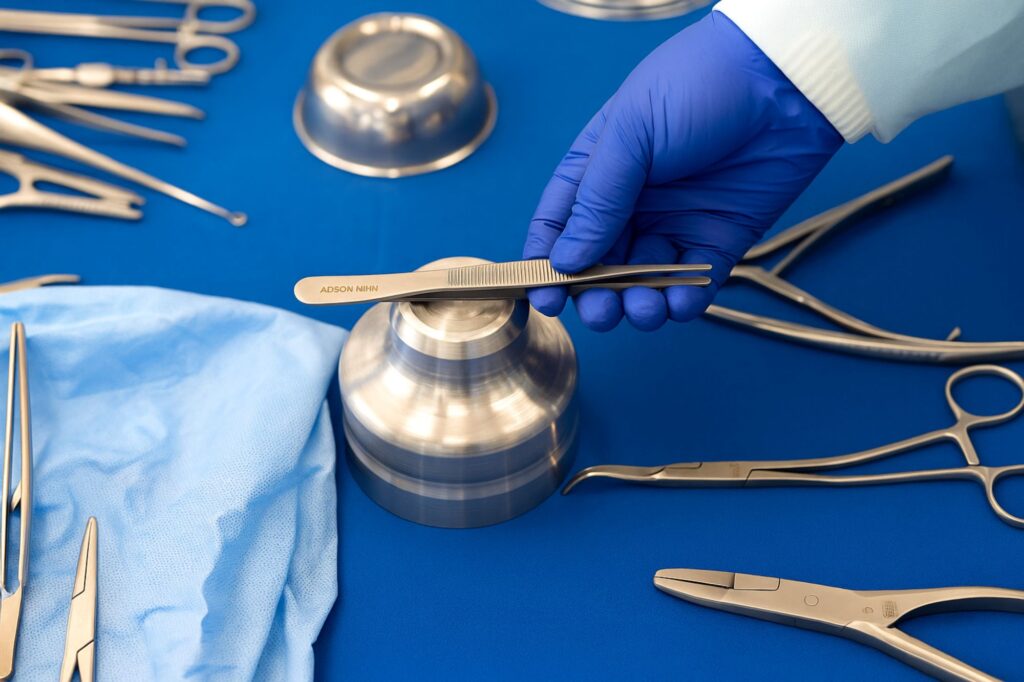
In the world of surgical asset tracking, there is a common misconception that laser etching is a “one-and-done” commodity service. Hospitals often ask: “Will this mark last forever?” The honest answer isn’t a simple yes or no. The efficacy of a laser barcode is a delicate balancing act—what we call the Golden Mean of marking. You want a mark dark enough to scan reliably, but not so deep that it creates a microscopic crevice or “canyon” in the steel where bioburden and bacteria can hide.
Achieving this balance depends on a “Trinity of Care” involving the instrument’s history, the hospital’s internal protocols, and our specialized etching process.
1. The Starting Point: Instrument “DNA” and Condition
A laser behaves differently depending on what it touches. The quality of the mark is fundamentally tied to the “health” of the instrument at the moment of onboarding.
- Material Composition: The specific grade of stainless steel (Martensitic vs. Austenitic) dictates how the metal reacts to thermal energy.
- Surface Real Estate: Etching requires an adequate, flat surface area to ensure the 2D data matrix is readable by scanners.
- Existing “Scars”: Instruments with prior pitting, corrosion, or scaling may not be suitable for marking, as the laser can exacerbate existing structural weaknesses.
2. The Hospital’s Maintenance Ecosystem
Once the instrument returns to circulation, its environment determines the barcode’s “lifespan.” We have no control over the chemicals or handling it encounters daily, which is why maintenance is critical.
- Chemical Exposure: Harsh detergents or improper pH levels in the washing cycle can strip the passive layer, leading to oxidation around the mark.
- Regular Passivation: Just as a car needs waxing to protect its paint, surgical instruments require regular maintenance and passivation activities to improve readability and preserve the marking.
- Brushes: Use of harsh bristle brushes / scrubbers that can spoil the Chromium oxide layer are a strict no. These cause surface scratches that render a barcode unreadable. Always follow manufacturers IFUs in all cases to ensure longevity of the instrument as well as the mark.
3. Our Commitment: Validated Standards
At Pivot Smartflow, we mitigate the risks of “marking too deep” by following validated best practices.
- Precision parameters: We use standardized settings to ensure the mark sits on the “passive” surface rather than cutting deep into the core metal.
- Validation through Passivation: We don’t just etch; we perform restorative passivation using ultrasonic technology to enhance corrosion resistance immediately after the mark is made. (Read about our standards here)
The Bottom Line
Laser marking is a partnership. We provide the high-precision engineering and validated onboarding; the hospital provides the ongoing maintenance and adherence to clinical standards. When these two forces align, the result is a tracking system that remains accurate and safe for the entire lifecycle of the instrument.